

How Flatbed UV Printing Improves Productivity
Mar 24, 2023
Leave a message
Inevitably, many printing professionals will come to a point where they need to use additional equipment to increase their printing capacity. Do you invest in more of the same, move to something more industrial, or change the approach entirely? Making this decision is difficult; choosing the wrong investment can have serious consequences for the growth of a business.
Since a day cannot last more than 24 hours, investing in more efficient production methods is critical. Let's take a look at one of the most popular wide format printing products and examine the production method for a common application, printing on display boards.
Roll to Roll Printed Rigid Board
Roll-to-roll wide-format printers are the first choice for most small and medium-sized printing companies. Producing rigid panels for building site hoardings or event spaces is a three-step process:
1. Print on self-adhesive media
Once the media is loaded and the device is configured, the printing process can be fairly quick with the right device - especially if you're not printing in high quality mode. After your printout, you may need to wait for it to be ready to apply, depending on the ink you are using.
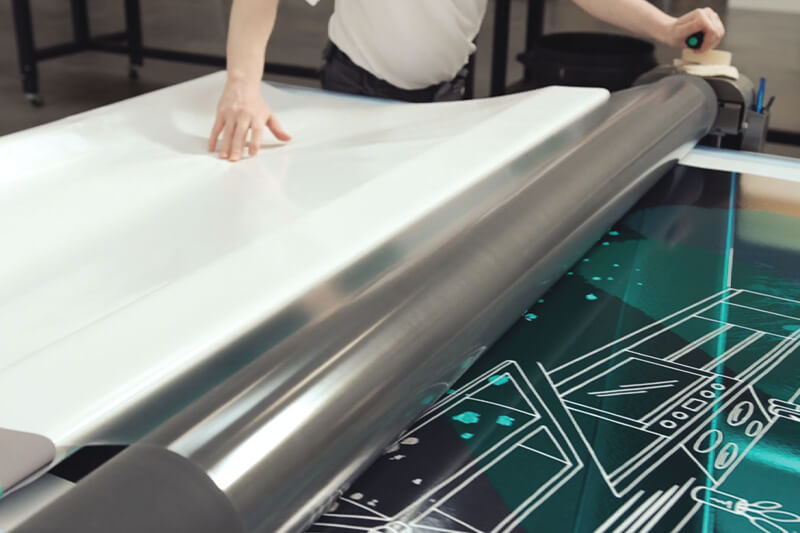
2. Laminate output
For outdoor work, permanent fixtures or floor graphics, it is recommended to cover the print with a protective laminate film. To do this effectively on larger pieces, you'll need a special laminating table that includes a full-width heated roller. Bubbles and creases aren't inevitable even with this method, but it's more reliable than trying to laminate large sheets any other way.
3. Application to the Board of Directors
Now that the media is laminated, the next step is to apply it to the rigid board. Again, the rollers on the application table make this easier and less prone to costly accidents.
Using this method, one or two skilled operators can produce about 3-4 boards per hour. Ultimately, your business can only increase production by increasing the amount of equipment and hiring more operators, which means investing in a larger facility and higher overhead.